

What are Audience-focused strategies in Google Ads?
Audience-focused strategies in Google Ads refer to the systematic use of audience data to control ad exposure by specifying which users are targeted, under what conditions, and at which stages of the decision-making process. Rather than relying solely on keyword matching or broad reach, these strategies leverage behavioural, demographic, and intent-based signals to align advertising delivery with user relevance. When implemented effectively, audience-focused strategies improve cost efficiency and lead quality by prioritizing high-intent users. When misapplied or poorly defined, they can result in inefficient budget allocation and diminished campaign performance.
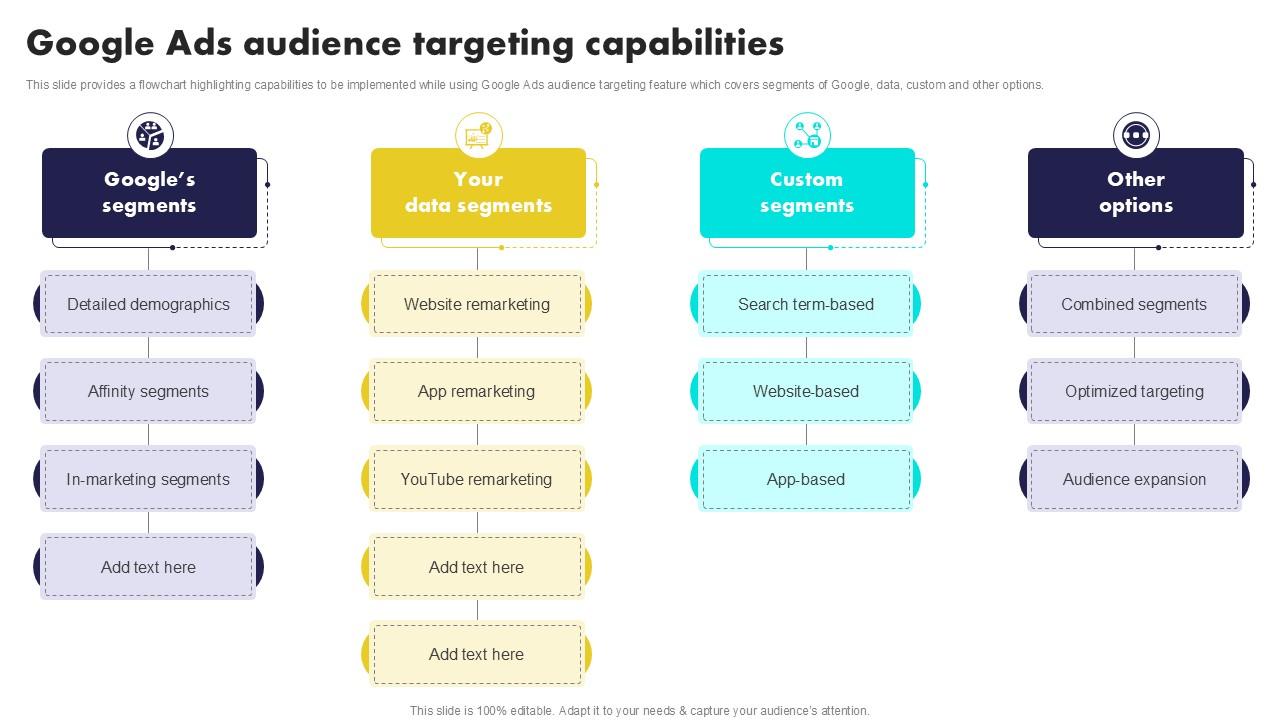
In this article we are going to talk about the different situations in which audience targeting should be used, and also we’re going to provide some example scenarios in actual campaigns.
1. Primarily Using Audience Targeting
In this case we’re using audience targeting because keywords alone don’t indicate if a user is in our target audience. That’s why we choose to rely more on audience targeting.
When do we apply additional audience targeting?
A good example is, when we’re using keywords that are more informational (How to…). (A good way to analyze our keywords is just look at the keyword list and decide if there is any intent behind our keywords.)
In actual Google Ads campaigns we run at Pineapple Digital, a lot of the search terms and the keywords we target are “How to’s”. For example, “How to run a bid max campaign”, “How to leverage smart bidding”, “What is target CPA”. Those are definitely much more informational queries. And they don’t indicate somebody who’s willing to start a paid advertising campaign with an agency.
And this is a very good example for layering audience targeting on top of our search advertising.
This leads to my second point, which is:
2. Layering Audiences with Keywords
In this case we combine audiences with keywords to bid more broadly. This helps reach our target audience even with loosely related terms.
Some good examples are:
2.1 Broad match with high-quality audience: Use a high-quality audience (like a customer list) and apply broad match keywords.
2.2 Dynamic Search Ads combined with high-quality audience: Use a high quality audience and launch dynamic search ads.
Dynamic search ads allows Google to freely decide what keywords and search terms to bid on. When using dynamic search ads, we provide a landing page on our website and Google determines what searches they should send to that page depending on the content of the page.
One great strategy for e-commerce and services-based businesses (businesses that target leads), is sending traffic to blog posts, educational guides, FAQ pages on a website. Using dynamic search, Google will read the content of the page and will understand the context, what this page is about.
BUT in this case, we don’t only want to use dynamic search ads, because that might bring in a very broad amount of traffic. SO, we are using dynamic search ads with a high-quality audience on top of it.
You have to ask yourself, do you need to create demand? And if you indeed need to create demand, you might avoid being limited with as much as audience targeting.
Do you need to limit your marketing to avoid high frequency rates?
If you’re running a lot of remarketing campaigns, that might not necessarily be a good idea because sometimes remarketing is really effective.
However, if you’re spending too much money on showing too many messages saturating that remarketing audience, that could be a waste of your budget.
In this case, you might want to limit your remarketing to avoid so much frequency.*
*Frequency refers to the number of times a specific person is shown your messaging.
Read Next: How to Analyze Audience Performance Reports

